Surname List
Name Index
Sources
Seventh Generation
10. 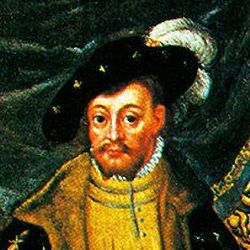 Albrecht "Achilles" VON BRANDENBURG (+)3 was born on 9 November 1414 in Tangermunde, Kreis Stendal, Sachsen (Saxony) Province, Margraviate of Brandenburg.3 The term "Margraviate of Brandenburg" came into existence in about 1414, and replaced "Germania" as the name that was used for most or all of present-day Germany. Margraviate was used until about 1700, when Prussia was formed and the area became known as the "Kingdom of Prussia." That name was used for the northern portion of Germany until 1918, when it was dropped at the end of World War I.
The term "German Empire" came into existence in 1871 for portions of Germany that were not part of Prussia, and it was used until 1918, when World War I ended. The area was known as the "Weimar Republic" until 1933, when Germany was re-named "Nazi Germany." That name was dropped in 1945 at the end of World War II. The area was then split into West Germany and East Germany until October 1990, when the country was unified as the "Federal Republic of Germany." He died on 11 March 1486 at the age of 71 in Frankfurt Am Main, Kreis Frankfurt, Hessen (Hesse) Province, Margraviate of Brandenburg.3 Life Sketch: "Albrecht was born at the Brandenburg residence of Tangermünde as the third son of the Nuremberg burgrave Frederick I and his wife, the Wittelsbach princess Elisabeth of Bavaria-Landshut. His father served as governor in Brandenburg; a few months after Albrecht's birth, he was enfeoffed with the electorate at the Council of Constance by the Luxembourg emperor Sigismund.
After passing some time at the court of Emperor Sigismund, Albrecht took part in the Hussite Wars, and afterwards distinguished himself whilst assisting Sigismund's successor, the Habsburg king Albert II of Germany, against the Hussites and their Polish allies. In 1435, he and his eldest brother John went on a pilgrimage to Jerusalem.
On the division of territory which followed his father's death in 1440, Albrecht received the Principality of Ansbach, while John took over the rule of Brandenburg as its elector. Although Albrecht's resources were meager, he soon took a leading place among the German princes and was especially prominent in resisting the attempts of the towns to obtain self-government.
Nevertheless, Albrecht's plans to re-unite the former Duchy of Franconia under his rule failed: in 1443, he formed a league directed mainly against the Imperial City of Nuremberg, over which his late father had formerly exercised the rights of burgrave. It was not until 1448, however, that he found a pretext for attack. After initial military successes in the First Margrave War, he was defeated at the Battle of Pillenreuther Weiher, resulting in the Treaty of Bamberg (22 June 1450), which forced Albrecht to return all of the conquered territory and to recognize the independence of Nuremberg and its associated towns.
Albrecht supported the Habsburg emperor Frederick III in his struggle with the princes who desired reforms in the Holy Roman Empire, and in return for this loyalty received many marks of favour from Frederick, including extensive judicial rights which aroused considerable irritation among neighbouring rulers.
In 1457, Albrecht arranged a marriage between his eldest son John, and Margaret, daughter of William III, Landgrave of Thuringia, who inherited the claims upon Hungary and Bohemia of her mother, a granddaughter of Emperor Sigismund. The attempt to secure these thrones for the Hohenzollerns through this marriage failed, and a similar fate befell Albrecht's efforts to revive in his own favour the disused title of duke of Franconia.
The sharp dissensions which existed among the princes over the question of reform culminated in the Bavarian War from 1459 to 1463, when Albrecht was confronted with a league under the leadership of Elector Palatine Frederick I and his Wittelsbach cousin Duke Louis IX of Bavaria-Landshut. Though defeated in the struggle, Albrecht continued fighting against Prince-bishop Rudolf II of Würzburg and even forged an alliance with his former enemy, the Bohemian king George of Poděbrady, a step which caused Pope Paul II to place him under the ban.
Albrecht permanently resided at Ansbach from 1460; he also inherited the Principality of Kulmbach upon the death of his brother John in 1464.
In 1471, Albrecht became Elector of Brandenburg, owing to the abdication of his remaining brother, Elector Frederick II, the year before. Now sole ruler over the entire Hohenzollern estates, he was soon actively engaged in their administration. By the 1472 Treaty of Prenzlau he ended the War of the Succession of Stettin, bringing the Duchy of Pomerania also under his supremacy.
Having established his right to levy a tonnage on wines in the mark, he issued in February 1473 the Dispositio Achillea, which decreed that the Margraviate of Brandenburg should descend in its entirety to the eldest son, while the younger sons should receive the Franconian possessions of the family. After treating in vain for a marriage between one of his sons and Mary of Burgundy, daughter and heiress of Duke Charles the Bold, Albrecht handed over the government of Brandenburg to his eldest son John Cicero, and returned to his Franconian possessions.
Albrecht's main attention afterwards was claimed by the business of the empire. Seriously ill, he took part in the imperial election of 1486 which selected Maximilian of Austria as King of the Romans at Frankfurt Cathedral. A few weeks later, in March, Albrecht died while still staying in Frankfurt; he was buried in the Heilsbronn Abbey church near Ansbach. He left a considerable amount of treasure." He was buried in Heilsbronn, Kreis Ansbach, Bayern (Bavaria) Province, Margraviate of Brandenburg.3 in the Kloster Heilsbronn.
Albrecht "Achilles" VON BRANDENBURG (+) and Anna VON SACHSEN (+) were married on 12 November 1458 in Furstentum Ansbach, Margraviate of Brandenburg.3  Anna VON SACHSEN (+)3 was born on 7 March 1437 in Dresden, Sachsen (Saxony) Province, Margraviate of Brandenburg.3 She died on 31 October 1512 at the age of 75 in Ansbach, Kreis Ansbach, Bayern (Bavaria) Province, Margraviate of Brandenburg.3 She was buried in Heilsbronn, Kreis Ansbach, Bayern (Bavaria) Province, Margraviate of Brandenburg.3 in the Kloster Heilsbronn.
Albrecht "Achilles" VON BRANDENBURG (+) and Anna VON SACHSEN (+) had the following children:
+11 | i. | Johann Cicero VON BRANDENBURG (+). |