Surname List
Name Index
Sources
Fifteenth Generation
18. 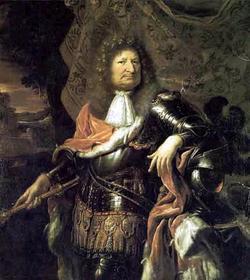 Friedrich William VON BRANDENBURG-SCHWEDT (HOHENZOLLERN) I, The Great Elector (+)5 was born on 16 February 1620 in Berlin, Brandenburg Province, Margraviate of Brandenburg.3,5 He died on 29 April 1688 at the age of 68 in Potsdam, Kreis Stadt, Brandenburg Province, Margraviate of Brandenburg.3,5 Life Sketch: "The founder of the Prussian ascendancy, father of King Friedrich 1st. He was a staunch pillar of the Calvinist faith, associated with the rising commercial class. He saw the importance of trade and promoted it vigorously. His reforms set up Prussia a strong position for elevation from duchy to kingdom, which was achieved under his son and successor.
He was also a military leader of wide renown, and his standing army would later become the model for the Prussian Army. He is notable for his joint victory with Swedish forces at the Battle of Warsaw. He is noted also for his use of broad directives and delegation of decision-making to his commanders which would later become the basis for the German doctrine doctrine 'Auftragstaktik.' He is further noted for using rapid mobility to defeat his foes." He was buried in Berlin, Brandenburg Province, Margraviate of Brandenburg.3 in the Berliner Dom. Family History: "Hohenzollern Dynasty, dynasty prominent in European history, chiefly as the ruling house of Brandenburg-Prussia (1415–1918) and of imperial Germany (1871–1918). It takes its name from a castle in Swabia first mentioned as Zolorin or Zolre (the modern Hohenzollern, south of Tübingen, in the Land Baden-Württemberg). Burchard I, the first recorded ancestor of the dynasty, was count of Zollern in the 11th century. In the third and fourth generation from him two lines were formed: that of Zollern-Hohenberg, extinct in all its branches by 1486, and that of the burgraves of Nürnberg, from which all the branches surviving into modern times derived.
Frederick III of Zollern (d. c. 1200), husband of the heiress of the former burgraves of Nürnberg, himself became burgrave in 1192 as Frederick I. Between his two sons, Conrad and Frederick, the first dynastic division of lasting consequence took place: that between the line later known as Franconian (burgraves of Nürnberg, later electors of Brandenburg, kings in Prussia, kings of Prussia, German emperors) and the Swabian line (counts of Zollern, of Hohenzollern, of Zollern-Schalksburg, of Haigerloch, etc.; princes of Hohenzollern-Hechingen, princes of Hohenzollern-Sigmaringen, princes of Hohenzollern, princes and then kings of Romania). There is some doubt about the seniority of the Franconian and of the Swabian lines: was Conrad I, burgrave of Nürnberg, the elder son, or was Frederick IV of Zollern?
The Franconian acquisitions of the burgraves of Nürnberg began when Frederick III (d. 1297) got possession of Bayreuth, and his descendants acquired Ansbach and Kulmbach. For a long time this group of territories was more important to the dynasty than Brandenburg. Then Frederick VI was appointed margrave of Brandenburg in 1411 and elector, as Frederick I, in 1415.
The rise of the Brandenburg Hohenzollerns (who became Lutheran at the Reformation but turned to Calvinism in 1613) was accompanied by considerable acquisitions of territory in the 15th, 16th and 17th centuries. One of the most significant acquisitions was made by a junior member of the house in 1525—namely, the duchy of Prussia.
In 1701 the elector Frederick III of Brandenburg secured from the Holy Roman emperor Leopold I the title “king in Prussia.” The change to “king of Prussia” was not formally recognized until 1772, when Frederick the Great obtained it. The kings of Prussia retained their title of electors of Brandenburg until the dissolution of the Holy Roman Empire in 1806. In 1871 William I of Prussia became German emperor. Both Prussian and German sovereignties were lost in 1918, at the end of World War I.
The Swabian line remained Catholic at the Reformation. It was in this line that the name Hohenzollern, as distinct from Zollern, first came into use—with Frederick IX. The Hechingen and Sigmaringen branches attained princely rank in 1623 but surrendered their sovereign status to Prussia in 1849. With the extinction of the Hechingen branch 20 years later, Charles Anton, head of the Sigmaringen, received the style prince (Fürst) von Hohenzollern, without territorial qualification. His second son, Charles, became prince of Romania in 1866 and king as Carol I in 1881; the candidature of the elder son, Leopold, for the Spanish throne had been one of the immediate causes of the Franco-German War of 1870–71. Leopold’s son, Ferdinand, succeeded his uncle in Romania in 1914, where his descendants, who were brought up in the Orthodox faith, ruled until 1947."
"Hohenzollern Dynasty". Encyclopædia Britannica. Encyclopædia Britannica Online.
Encyclopædia Britannica Inc., 2012. Web. 17 Oct. 2012
<http://www.britannica.com/EBchecked/topic/268949/Hohenzollern-Dynasty>.
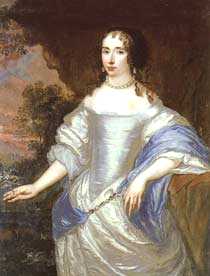 Luise Henriette VON ORANGE-NASSAU3 was born on 7 December 1627 in Den Haag Centrum, Den Haag Municipality, Zuid-Holland, Netherlands.3 She died on 18 June 1667 at the age of 39 in Berlin, Brandenburg Province, Kingdom of Preussen (Prussia).3 She was buried in Berlin, Brandenburg Province, Kingdom of Preussen (Prussia).3 in the Berliner Dom.
Friedrich William VON BRANDENBURG-SCHWEDT (HOHENZOLLERN) I, The Great Elector (+) and Dorothea VON SCHLESWIG-HOLSTEIN (+) were married.5 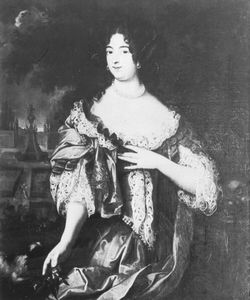 Dorothea VON SCHLESWIG-HOLSTEIN (+)3 was born on 9 October 1636 in Glucksburg, Kreis Schleswig-Flensburg, Schleswig-Holstein Province, Margraviate of Brandenburg.3 She was from Schleswig-Holstein-Sonderburg-Glucksburg. She died on 6 August 1689 at the age of 52 in Karlovy Vary, Okres Karlovy Vary, Karlovy Vary, Czechia (Czech Republic).3 She was buried in Berlin, Brandenburg Province, Margraviate of Brandenburg.3 in the Berliner Dom.
Friedrich William VON BRANDENBURG-SCHWEDT (HOHENZOLLERN) I, The Great Elector (+) and Dorothea VON SCHLESWIG-HOLSTEIN (+) had the following children:
19 | i. | Christian Ludwig VON BRANDENBURG-SCHWEDT (HOHENZOLLERN)3 was born in 1667.3 He died in 1734 at the age of 67.3 He was buried in Berlin, Brandenburg Province, Kingdom of Preussen (Prussia).3 in the Berliner Dom. |
20 | ii. | Philipp Wilhelm VON BRANDENBURG-SCHWEDT (HOHENZOLLERN)3 was born in 1669.3 He died in 1711 at the age of 42.3 He was buried in Berlin, Brandenburg Province, Kingdom of Preussen (Prussia). in the Berliner Dom. |
+21 | iii. | Albrecht Friedrich "Alfred" VON BRANDENBURG-SCHWEDT (HOHENZOLLERN) (+). |
22 | iv. | Karl Philipp VON BRANDENBURG-SCHWEDT (HOHENZOLLERN)3 was born in 1673.3 He died in 1695 at the age of 22.3 He was buried in Berlin, Brandenburg Province, Kingdom of Preussen (Prussia).3 in the Berliner Dom. |
23 | v. | Dorothea VON BRANDENBURG-SCHWEDT (HOHENZOLLERN)3 was born in 1675.3 She died in 1676 at the age of 1.3 She was buried.3 |